10.30.2010
What it means when you say "literally" - The Oatmeal
This is what it means when you say 'literally'.

10.05.2010
Commissioning
VERITAS is now operating at full capacity. Over the past two weeks we successfully repaired most of the primary systems that had either been taken offline by the computer hack or somehow got broken over the summer. We're now operating with ~1% dead pixels across the telescopes of the entire experiment (this is about 10 times less than we typically operate with, we were really efficient at diagnosing and fixing problems).
I have finally got my equipment set up in one of the telescope control trailers. It's a pretty nice setup, I've got a nice big screen, all my electronics, decent internet, and because I'm alone working in there, I can play music and such without any issues. Tonight I'm replacing one of my colleagues on shift, so I'm not working on my photometer (I am also pretty pooped and would rather take a bit of time off to watch a movie or something, so I'm not going to be doing any FPGA debugging tonight.
It's my birthday in a couple weeks, and I've decided to go on a road trip to Las Vegas. I'm going to spend a few days there and also visit the Grand Canyon and Meteor Crater. I'm planning on going to see Penn & Teller live at the Rio while I'm in Vegas, but I'm not sure about the other shows (Treasure Island sounds interesting). I've reserved 5 nights at the New York - New York Hotel and Casino on the Strip. I spent a little more than I was hoping to, but the place looks really nice and I don't often get to splurge like this.
There has been some interesting science going on here recently. The Crab Nebula (M1) was detected flaring by AGILE at which point a few other observatories (at various wavelengths) started observing it also. To my knowledge, no one else got any data on this flare (including VERITAS) as it only lasted two days. The Crab is supposed to be the standard candle for Gamma-ray observations (ie, it is not supposed to change), so there has been alot of discussion on this matter as of late. Once I track down the interesting ones, I'll link to the ATELs (Astronomer's Telegrams).
9.18.2010
9.14.2010
I have spent a good portion of the last few days trying to take telescope alignment data.The first night, we had network issues and weren't able to start until about 9PM. The process should start at 7, when the sky is still a bit bright, so that you can see the different mirrors of the telescope properly. This acts as your template. Once the sky gets dark, however, it makes it alot harder to get a good template. In prinicipal you can use the moon to light up the mirror facets, but the moon was too low the first night to do so. Last night, the weather was pretty bad, cloudy and such, so we didn't even bother setting up the alignment tool, and finally, tonight, I got lucky. We only managed to get a template image once it was fairly dark, but it should still be fine.
The way the alignment works is really interesting. You begin by pointing the telescope at a star. In prinicple, all the mirror facets should be lit up if you are at the focal point of the telescope and looking at the dish. However, some mirrors will be misaligned and they won't be lit up. If you move the telescope up, down, left or right with respect to the target star, eventually you can find a position so that a misaligned mirror facet will be lit up. Then, the angle difference between the star and your new pointing direction is related to the angle that the mirror is misaligned by simple geometry.
A coworker of mine, Andrew McCann, who developed this method, has published a paper. The arXiv print can be found here. If anything, the figures are interesting.
I had to change dorms this morning. I have relocated to one of the sub-summits of Mount Hopkins, to the location of an automated telescope array called mEarth. I have the dorm to myself, which is both a blessing and a curse. It does get mighty creepy staying up on the Ridge at night, and the bed in the mEarth building is pretty tiny.
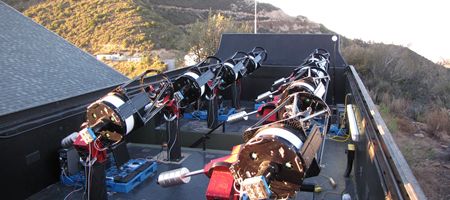 |
| mEarth has 8 16" telescopes. Note that this image is not my own; I pulled it from rcopticalsystems.com |
9.10.2010
Back to work.
After a valiant effort by the day crew here, the VERITAS computer array is back online (mostly). This means that we (the observers) can start getting the array working again. I've been put in charge of getting one of the calibration systems (called the LED Flashers, I'll write about them later) up and running. Luckily, it's not time critical, I can do it at any time of the day, which makes life a lot easier.
9.07.2010
Hack'd
So, the VERITAS computer network was hacked at some point last week. Out of some 80 machines, we found 7 compromised machines, including our array controller box, and all of them have to be rebuilt from scratch. We are currently operating in a state where we can't even steer the telescopes (which means that for people like me who are not system engineers, there isn't much to do).
So, Saturday another observer and I went to the Pima Air and Space Museum (a few photos have been attached) and then yesterday to the Pima County Desert Museum. Both the museums are really nice (even though the Desert Museum is essentially just some fenced in desert that you need to pay admission for) but they have some pretty cool animals.
Most of the excitement started when we left the Desert Museum. In a nutshell, the catalytic converter on my car rusted through and detached the rear exhaust system from anything structurally sound. So, the entire muffler assembly was just holding itself on by the oxygen sensor and a set of bolts on the back. I managed to fix it with 2 coat hangers and some duck tape, but the car is crazy loud now and I need to replace the catalytic converter. It's a good thing that this didn't happen on (for example) one of the highways in the middle of Oklahoma. I didn't have a chance to take pictures (too dirty) but as soon as the ground dries I'm going to grab my camera so I can take pictures of my handiwork.
Here are three videos that I've decided to post. Two of which are a bit old (one dating from when I was driving through New Mexico), but one from earlier today. Near the end of the third, there is a lightning strike in the field of view, then some crazy loud thunder. Unfortunately, neither of these effects came out well.


9.03.2010
Mirror swappage
Two days ago we began pulling mirrors off of Telescope 2 so that they could be replaced and recoated. It's a lengthy process where two people go up with boom lifts, take off a few mirrors at a time, and then bring them back down to the people waiting on the ground who package them up and then wait for the next batch. The pictures below are somewhat self explanatory.


 |
| "This picture doesn't encapsulate how bitch-ass hot it was outside." -Emmett |


Yesterday we put the mirrors back on ( a horrible job consisting entirely of 'hurry up and wait'). It's been really hot here, 35C and higher, so I'm pretty toasted right now, even by local standards.
Subscribe to:
Posts (Atom)